Apple iPhone 8 vs LG G6

Design
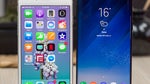
Apple bets on a legacy iPhone 8 design and retains the familiar home button placement, while the G6 intros a forward-looking 2:1 aspect ratio.
Apple used the same “surfboard” design for the iPhone 8 that its adherents know and have been accustomed to for a few years now, but introduced a brand new glass back so that it can throw in wireless charging. It undoubtedly feels premium and solid in the hand, but will break easier than the predecessor's metal housing if you drop it. That's not a con against the G6, of course, as this one also sports an all-glass design that is not immune to shattering when it hits the pavement.
Yes, we are talking about screen-to-body ratio, as moving the home key and finger scanner duties at the back, shrinking the bezels all around, and implementing an unorthodox display proportions has allowed LG to stuff a largish 5.7” display in a body akin to a 5.2-incher, while the iPhone's top and bottom bezels encroach too much in comparison.

5.45 x 2.65 x 0.29 inches
138.4 x 67.3 x 7.3 mm
5.22 oz (148 g)

5.86 x 2.83 x 0.31 inches
148.9 x 71.9 x 7.9 mm
5.75 oz (163 g)

5.45 x 2.65 x 0.29 inches
138.4 x 67.3 x 7.3 mm
5.22 oz (148 g)

5.86 x 2.83 x 0.31 inches
148.9 x 71.9 x 7.9 mm
5.75 oz (163 g)
See the full Apple iPhone 8 vs LG G6 size comparison or compare them to other phones using our Size Comparison tool.
Displays
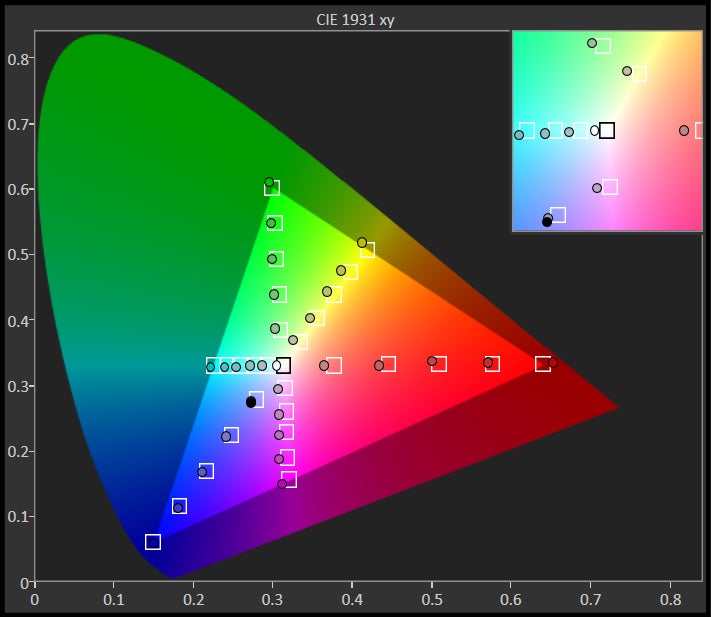
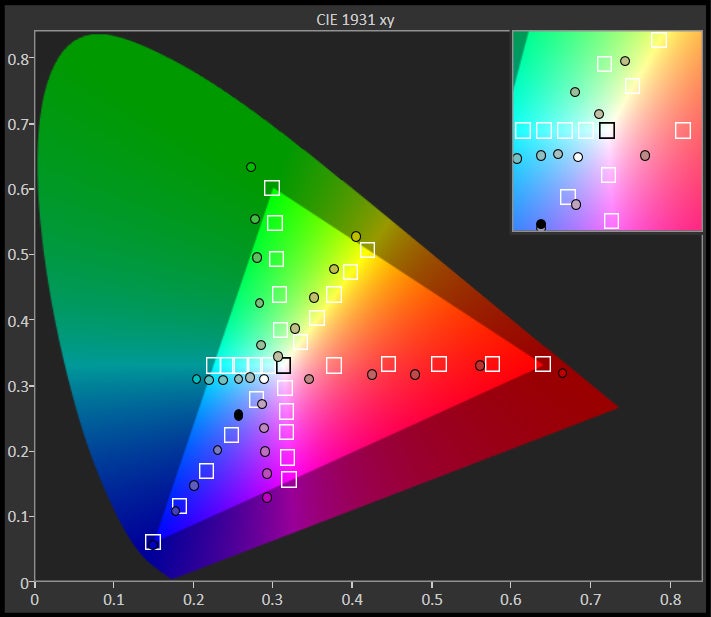
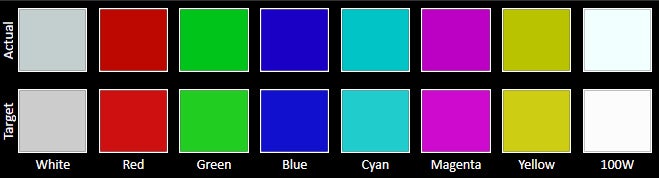
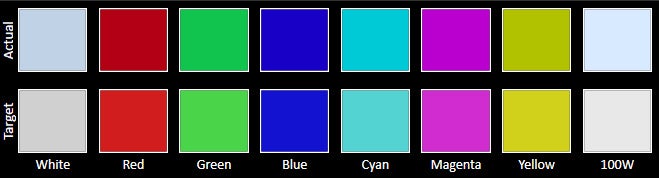
Both displays cover the DCI-P3 “wide color” gamut, but the iPhone 8 exhibits more credible presentation and better outdoor visibility.

Speaking of displays, they may diverge at size and resolution (5.7” 1440x2880 pixels for the G6 against 750 x 1334 pixels on the 4.7” iPhone 8 panel), but converge at their ability to represent rich color standards like the wider DCI-P3 gamut. This comes in handy when watching high dynamic range imagery, either from services like Netflix, or taken from the iPhone's own “wide color” camera. The G6 has the more pixels on the display, but the iPhone's resolution is perfectly adequate for the screen size, too. LG throws in options like always-on display that can show you time/date and notification info on a locked screen, but is somewhat of a battery hog on a handset that doesn't flaunt a very good battery life to begin with.


Interface and functionality

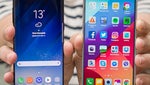
The iOS 11 interface on the iPhone 8, and the LG UI over Android 7 on the G6 are rather different to merit a direct comparison, as you can imagine. Still, there is a growing trend among major Android makers to dispense with the app drawer, like their Chinese counterparts have been doing for years, and as iOS was conceived to begin with. The LG UI still allows you to have the classic app drawer as an option, unlike the iPhone 8, which offers folders to group up your apps, and homescreens upon homescreens to nestle them. Both handsets offer a widget system for your homescreens, too, though the iPhone limits it to a dedicated page.
The iPhone 8 is running iOS 11 right out of the box
LG explicitly touts the split-screen multitasking that is present on the G6 not because it is something new, or because iPhones don't have it, but rather since the new 18:9 aspect ratio of the display is better suited for the purpose than a traditional, 16:9 one, which is a small enhancement if you use that feature. In theory, the taller, narrower aspect ratio of the G6 display is better suited for fitting more content, though whether that's the case would depend on the use case and the app you're in. When it comes to video scaling, most footage is not shot with the G6 aspect ratio, so clips get cropped, black-barred, or stretched out of proportion to fit 2:1 in the LG-provided compatibility mode.
UI of the LG G6
Overall, iOS 11 is the more polished and uniform interface, offering you access to globally popular services like Apple Music, iMessage, Health, or Apple Pay, while the App Store brings you a more coherent and visually appealing app ecosystem. The G6, on the other hand, offers way more customization, down to theming or rearranging the navigational keys, making it the better choice for folks who like options and choices, and are fond of tinkering, rather than the “just works” approach of Apple.
Processors and memory
Last year's Snapdragon in the G6 gets smoked by Apple's new Bionic chipset.
The G6 runs on the 2016-finest Snapdragon 821, which, while not a weak chipset, is made with an older production node than the Bionic processor of the iPhone 8, thus scores times worse in benchmarks. In everyday usage you won't notice the G6 to be underpowered, except in very heavy games or AR shenanigans, but the 14nm chipset definitely takes a heavier toll on the battery than the 10nm silicon in the iPhone 8.
Camera
The iPhone 8 camera outshines the G6 in video recording, dynamic range, and color fidelity, while LG counters with a dual camera and plenty of manual modes to tinker with.

While keeping the 12 MP resolution, Apple has upgraded the iPhone 8 camera with an improved sensor that is able to soak more photons coming in. The G6 rises up against it with a 13 MP main camera sensor that has smaller, 1.1 vs 1.2 micron pixels, but adds another 13 MP sidekick with a wide-angle lens. There is a 7 MP selfie cam on the iPhone, while the G6 has a 5 MP shooter, also with an f/2.2 aperture but a lens of much wider angle.
Apple's new dedicated image signal processor makes for a very speedy camera that always shoots in auto HDR mode, there is not even a toggle for HDR in the app, as the software goes for it on its own. The G6 is slower to take and record a shot, yet not to the extent that the average user will notice a grand difference.
Image quality
Getting down to brass tacks, the LG G6 pulled a solid performance in daylight, albeit with color presentation that is very often oversaturated compared to what's in front of the lens. The iPhone 8 produces true-to-scene colors that might seem a tad lifeless in comparison, yet it manages to capture every slight nuance, which, coupled with the excellent dynamic range and lower amounts of noise make it a formidable opponent for the G6.

Here we have to again mention that both phones shoot in auto HDR, and on the cloudy day we had the HDR shots were prevalent, which may explain the good dynamic range on all of the resulting pictures. The G6 takes way more time to save the shot when the tiny “HDR” prompt is present in the top right corner of the app interface, though.
Apple iPhone 8 vs LG G6 sample images
Video
Where the iPhone shines above the fray is video recording, as usual, since this year the new Bionic chipset and custom Apple-designed ISP allow for recording high-def 4K video with the smooth 60fps, and 1080p slow-mo with 240fps. No matter how you're shooting, the camera easily handles varying lighting conditions and seamlessly reacquires focus and adjusts exposure as needed. The mono audio recording leaves a bit to be desired compared to the stereo quality of the G6, but the iPhone 8 does offer good noise-cancellation that weeds out ambient fluff when you start to speak behind the camera. The 60fps footage is out of this world, yet a minute of it will cost you about 400MB in storage, so be advised.


Media
We already mentioned that the two displays will let you enjoy HDR and Dolby Vision movies with wider color and dynamic range than their basic subscription counterparts. The 2:1 aspect ratio of the G6, however, means that by default the screen area visible when displaying most shows will be only about 15% larger than that on the iPhone 8, unless you are watching in the stretched-out compatibility mode. While still bigger, that's far less than what users would imagine when they hear a 4.7” vs 5.7” display battle.
Call quality
We tested the iPhone 8 for call quality against the G6 paying particular attention for any static noise or beepy sounds that some units are said to be laden with, which Apple mentioned will be fixed with a software update. There were no issues, though, and the voices came loud and clear through the earpiece without unusual artifacts.

Battery
Much longer battery life on the iPhone 8, but fast charging will cost you extra.
Thanks to the more frugal 10nm chipset and other software and hardware optimizations, the iPhone 8 lasted an hour more on a charge than its predecessor on our battery benchmark test, despite having a smaller, 1821 mAh battery. LG's power-hungry Quad HD+ screen and the aging 14nm processor eked out just 6 hours of screen-on time out of the 3300 mAh pack at the same test, a much shorter endurance than the iPhone. When it comes to charging speeds, the roles are reversed – the G6 charges for hour and a half, while the iPhone 8 needs more than two hours with the stock charger.
With Apple's souped-up 29W adapter, you'd be able to top up quicker, as the phone certainly supports fast charging, but that will cost you $49. Alternatively, Apple lists that any third-party USB-C power adapters that supports USB Power Delivery (USB-PD) will work with the respective Lightning adapter to top up your iPhone 50% in 30 minutes, too.
Both handsets have wireless charging built in, but you'd have to wait a bit to get Apple's fancy multi-device pad, and can soothe your pains with approved third-party chargers from Belkin or Mophie in the meantime.
Conclusion
When all is said and done, the iPhone 8 betters the G6 in a few key areas like camera quality, battery life, basic storage, processing speed and LTE network compatibility. And it should, since it is the more expensive one, starting at $699, against the LG G6 that hovers around the $500 mark at the moment, not to mention some BOGO offers or other enticements over at US carrier shops.

When we add the better call and speaker quality, the coherent app ecosystem, as well as the higher resale value of the iPhone, in the end you get what you pay for with both handsets.
Apple iPhone 8
Pros
- Great camera dynamic range
- Smooth 60fps 4K video
- Good battery life
- Coherent interface and app ecosystem
- 64GB base storage
LG G6
Pros
- Very compact for the screen size
- Good pricing
- Secondary wide-angle camera
- Rich in options manual camera mode

Follow us on Google News


Things that are NOT allowed:
To help keep our community safe and free from spam, we apply temporary limits to newly created accounts: